Related Posts

General News Blog
My WordPress Blog
My WordPress Blog
Two different commercial establishments may use water coolers that are quite similar in size and capacity; still, the operation of both devices may differ. While one works without problems for many years, another device has problems with cooling, maintenance or the availability of water at all times.
The reason for this difference can be attributed to the research that was done before installing a commercial water cooler. Unfortunately, in most cases, businesses focus only on specifications without considering how the system will actually function in day-to-day operations.
One needs to remember that a good water cooler should work continuously, keep the water clean and safe, and provide stable performance in different conditions. Finalising the right system, therefore, requires looking beyond appearance or capacity and evaluating factors that influence long-term reliability.
In commercial environments, water coolers are used throughout the day. Offices, healthcare facilities, schools, and public spaces all depend on uninterrupted access to safe and clean drinking water.
Read More: Top 10 Ceiling Fan Manufacturers In India
When the system is not suited to the actual requirement, problems begin to appear gradually in the form of slow cooling, insufficient storage, rising maintenance needs, or inconsistent water quality. Choosing the right commercial water cooler from the beginning helps avoid these operational challenges later.
Now, you may wonder which things should be checked before finalising a commercial water cooler. Not to worry, this blog will tell you what features should be considered before buying a commercial water cooler for your business.
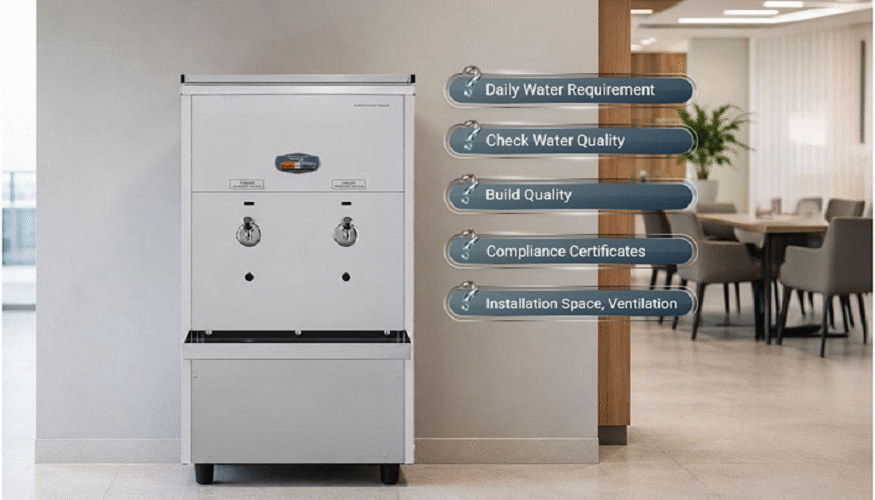
One of the first things to assess is how much water will be consumed daily, and do not forget to take into account the peak usage.
A smaller office may only require moderate capacity, while larger facilities with continuous movement often need systems capable of handling significantly higher demand. Estimating realistic usage can help you prevent installing an undersized or oversized water cooler.
Bigger hospitals, university campuses and factories have a significantly higher water demand, which a single commercial water cooler might not be able to sustain. For this, a centralised water purifier plant is installed to ensure a steady drinking water supply for all.
Water quality varies considerably depending on the source. Borewell, tanker, and municipal supply all of them generally carry different levels of dissolved impurities and microbial risks.
Read More: Waterproof Paint For Walls Vs Traditional Methods: What Builders Don’t Always Tell You
Testing the water before finalising a system helps determine whether technologies such as RO, UV, or UF purification are required. This ensures that the water cooler is equipped to handle the actual condition of the incoming water.
However, it is always better to install a commercial water cooler with an in-built multi-stage purifier, as water quality keeps changing. In some months, there might be dirt and dust in higher quantities and in other months, TDS levels might soar high.
Commercial systems are exposed to constant usage, making durability an important factor.
Materials used in the outer body, internal components, and dispensing mechanisms all influence long-term performance. Having corrosion resistance and a robust, durable body becomes especially important in environments where the system operates throughout the day.
Many commercial water coolers come with a stainless steel body, which enhances the hygiene and supply of drinking water seamlessly throughout the day.
Make sure whichever commercial water cooler you buy has a compliance certificate from BIS and related bodies, as commercial water coolers provide drinking water to a multitude of people.
The location of the water cooler influences both the performance and ease of use. Adequate ventilation is essential for efficient cooling, and a stable water and electricity supply is required for proper working of the system.
The system should also be positioned in a way that allows easy access for servicing and regular maintenance.
A commercial water cooler is expected to function consistently in environments where water access cannot be interrupted. Choosing the right system, therefore, requires evaluating not only immediate requirements but also long-term usability, maintenance, and water quality needs.
When factors such as capacity, purification, durability, and servicing are assessed together, businesses are better positioned to finalise a system that remains reliable and efficient over time.